

Looking back 20 years: how good is your long-term planning?

Written by Will Fooks
When I boarded a one-way flight in 2005 to London, after a video interview with Transport for London (TfL), I had no idea it would result in a time that would redefine my career. My first project dropped me straight into the deep end: a long-term strategy for the year 2025, T2025.
At the time, the team was still using Blackberries and were talking about big ideas like “working from home” . London was a buzz after the succcess of the Congestion Charge. The purpose of “T2025” was to set TfL’s priorities in concrete and secure funding for the - then - mega-far-off-project the Elizabeth Line (Crossrail), and other projects. It was also a fully-fledged transport strategy.
We now land in the forecast year, then the distant future, so I thought I’d look back on the work and see what we got right, and what we missed.
A caveat - this is my analysis and focuses on what i know about London. That said, the data is still insightful and highlights what we got right, what nearly landed, and where we missed.
T2025, twenty years on
What it got right: the big calls in 2005 that aged well
1. Rebuild the Tube and build the Elizabeth Line (Crossrail)
Tube upgrades and Crossrail at the very top of the investment list.
What happened: That bet was correct. Those are exactly the projects that carried London’s growth, and had impact around the world.
2. Public transport, not roads, is the backbone of a growing London
Assumed London could not “build its way out” of congestion with new roads. The strategy embedded this in policy (MTS 1 3C.16).Focused on more rail capacity (Overground, DLR, suburban rail upgrades) instead of road capacity (new roads).
What happened: London is now clearly a rail and public transport-first city, not a road-building city. This is even more impressive as new mayor’s had new agendas, but momentum still continued. While some understood this direction, many don’t undertand the tensions within the shift that played out over time.
3. Car dependency had to fall, and would if policy supported it
Explicitly targeted a big drop in car mode share and a shift to public transport, walking, cycling.
What happened: the three images show - the forecast for a major shift in how people travel relatively, the second chart shows that while this forecast was correct the shift was not as big as forecast, however, the third chart shows the impact on COVID on travel patterns.
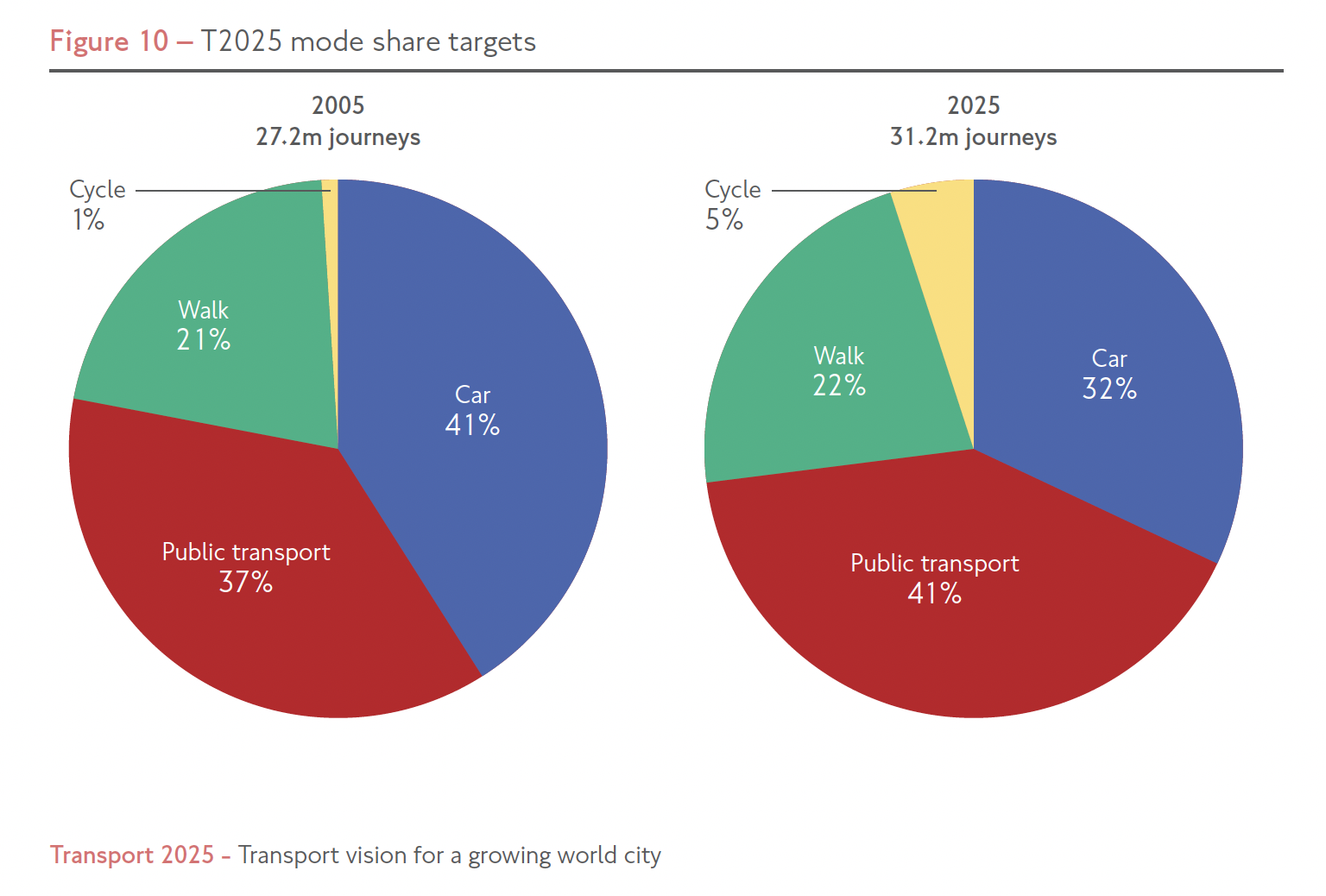
T2025 Planning forecasts for the change in way people travel
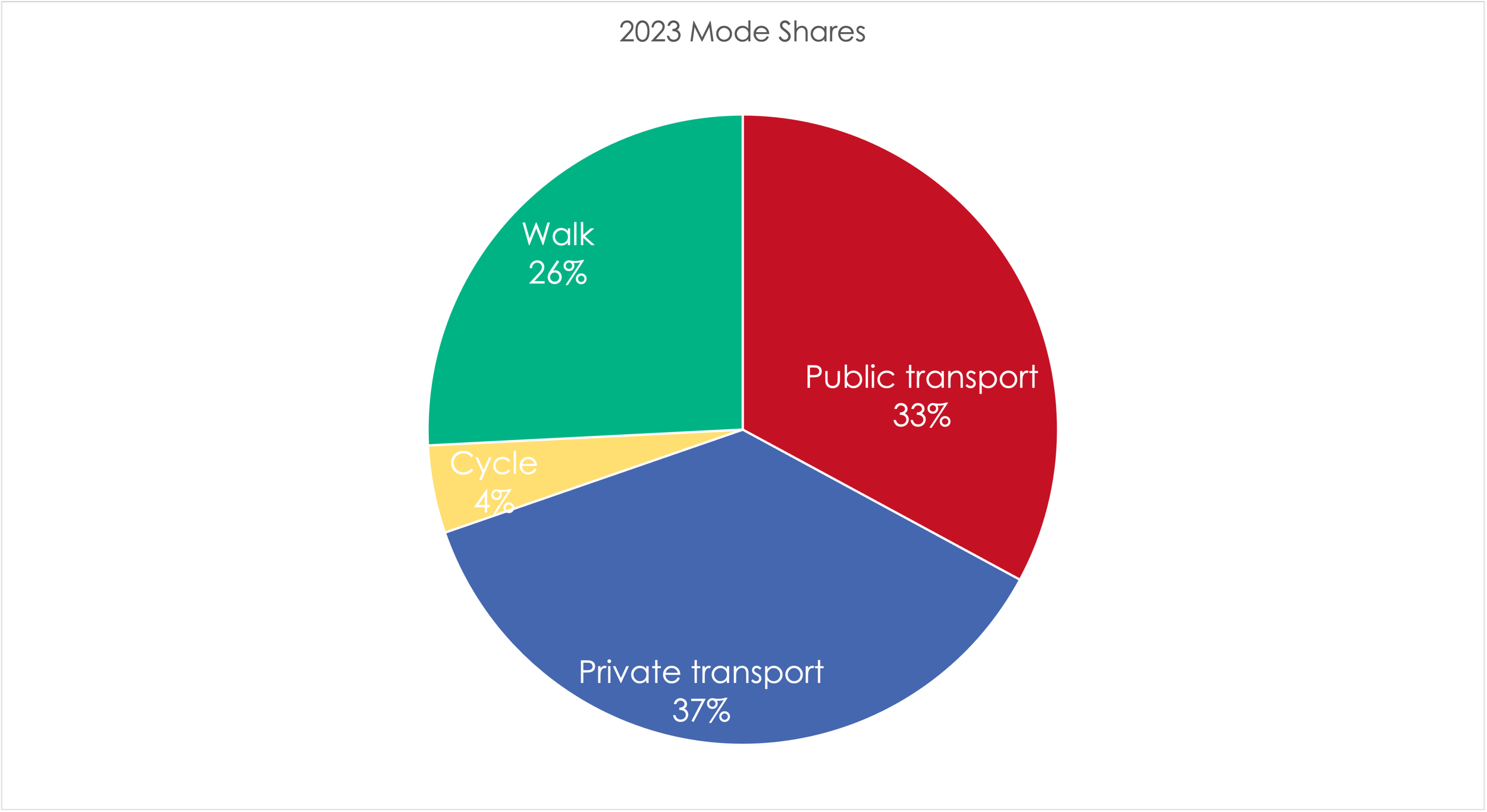
The 2023 numbers on the way people travel: the right trend
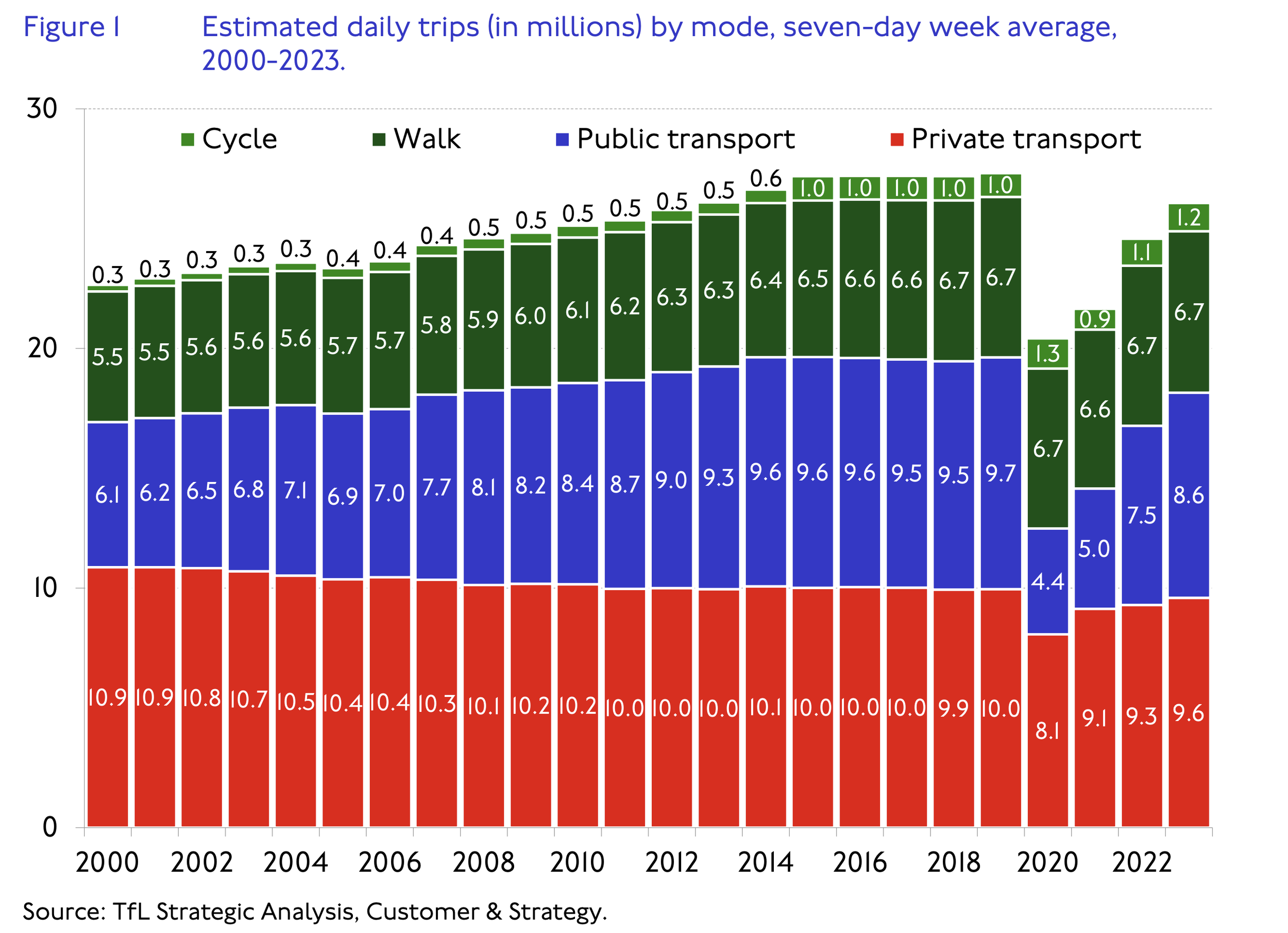
The above highights the impact on COVID on public transport (sorry for the change in colours between pie charts and graphs)
4. Climate and clean vehicles matter for transport, not just “nice to have”
CO₂ was central to policy but the levers around tackling surface based transport didn’t feature in the plan.
What happened: The modal breakdown was forward thinking but measures relating to road transport decarbonisation didn’t come until later. EV strategies came in around 2010, and though the forward plan referenced new technologies and the benefits, it didn’t really lean into them. This came later.
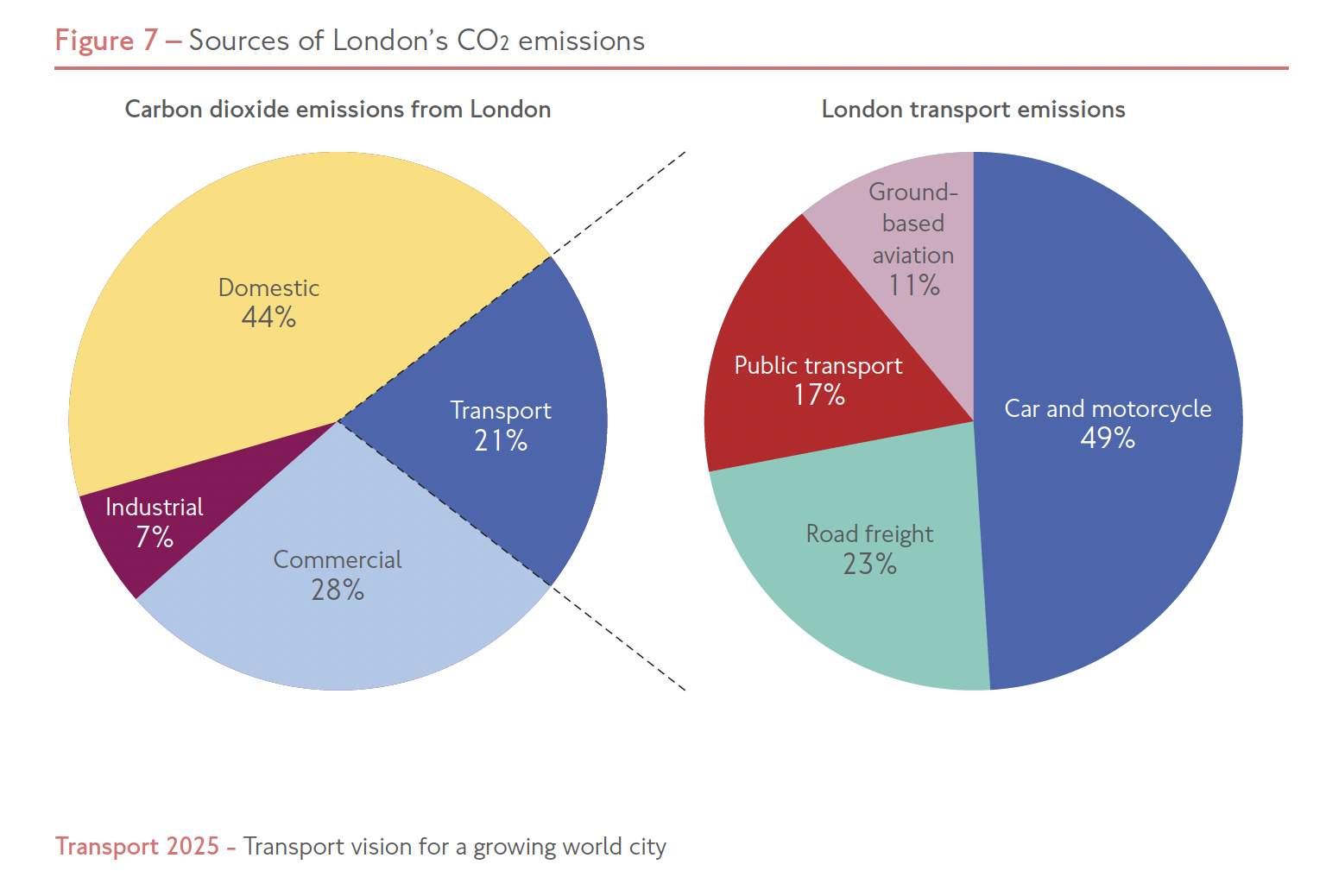
The T2025 breakdown of emissions was forward looking at the time
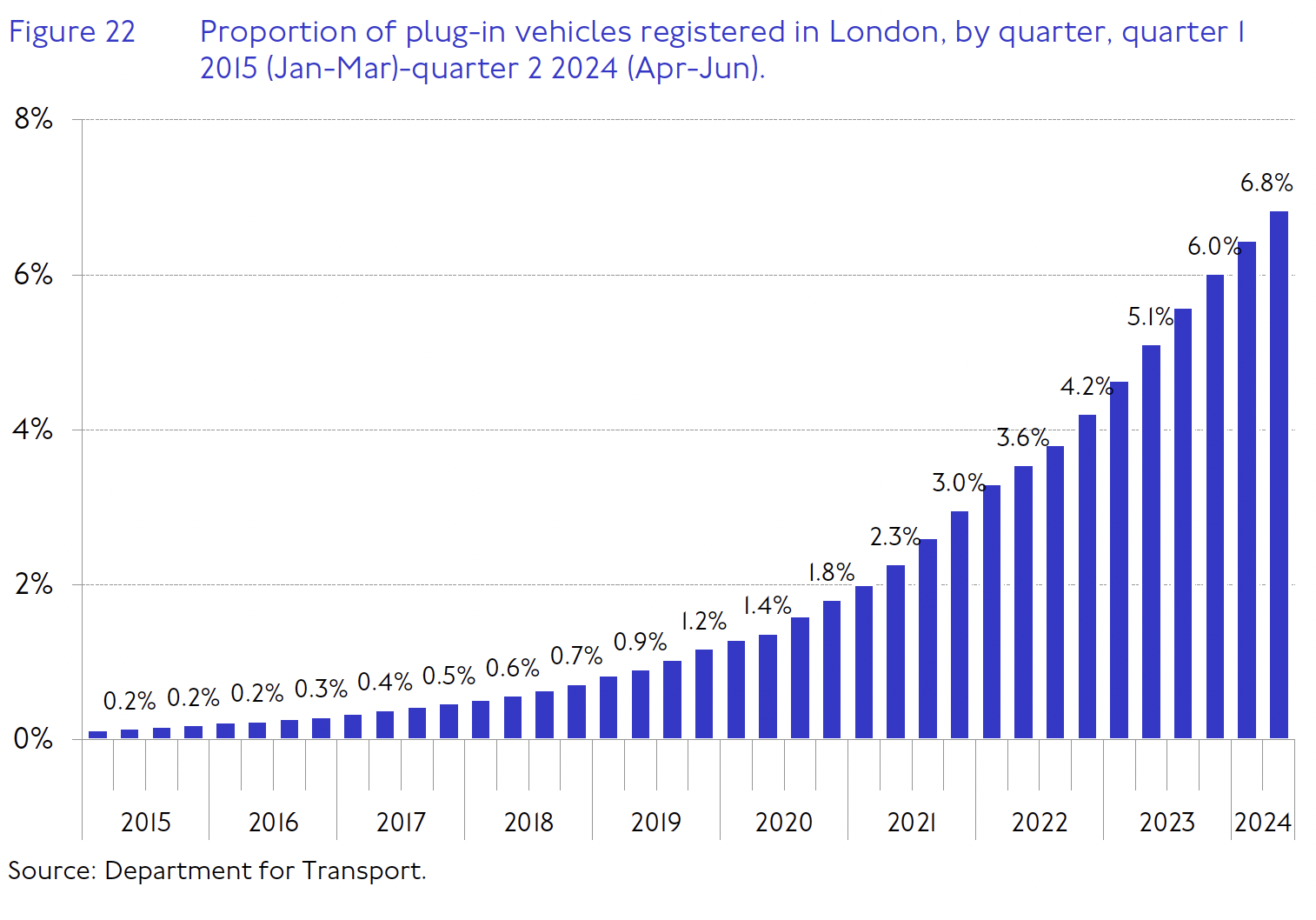
The plan did not plan for the subsequent investment and realisation of EVs.
5. Walking, cycling, and public realm need real investment
Recognised walking and cycling plus better streets as necessary alongside big rail schemes.
What happened: Paved the way for the cycle upgrades that followed. The strategy did not foresee the scale of what would come, but the direction of travel was broadly right. It’s almost funny now to remember how unthinkable it once seemed that Victoria Embankment could be anything other than a “traffic” corridor… and yet, here where are. Below are two photos; what is evident in these photos is that Victoria Embankment used to be a route mainly for the "hardened few” who braved it on a bike, whereas today it’s designed for everyone (and the impact on e-mobility). Leaning into where people actually ride bikes now is one of the most underrated forms of network planning.
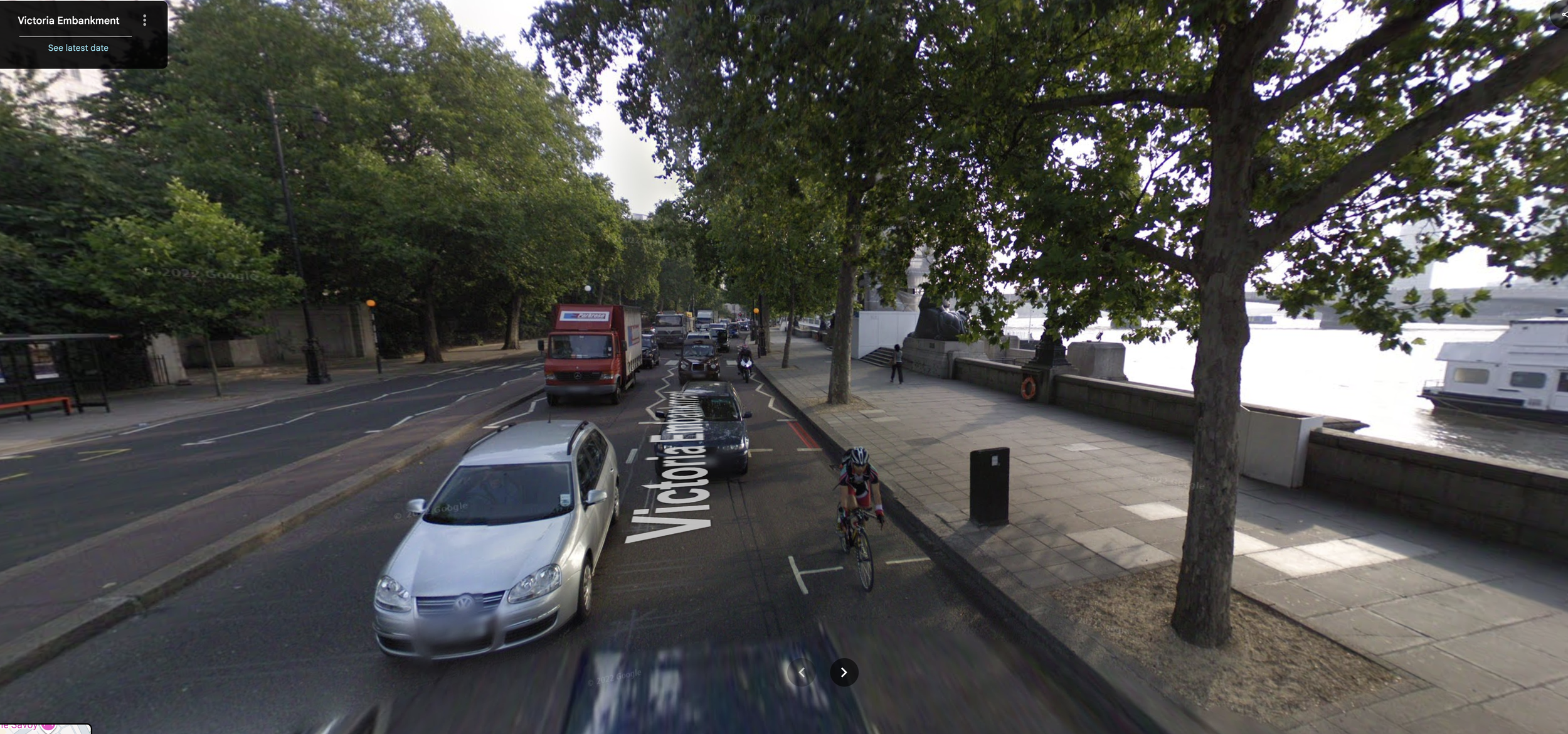
Victoria Embankment during T2025, Map data ©2008 Google
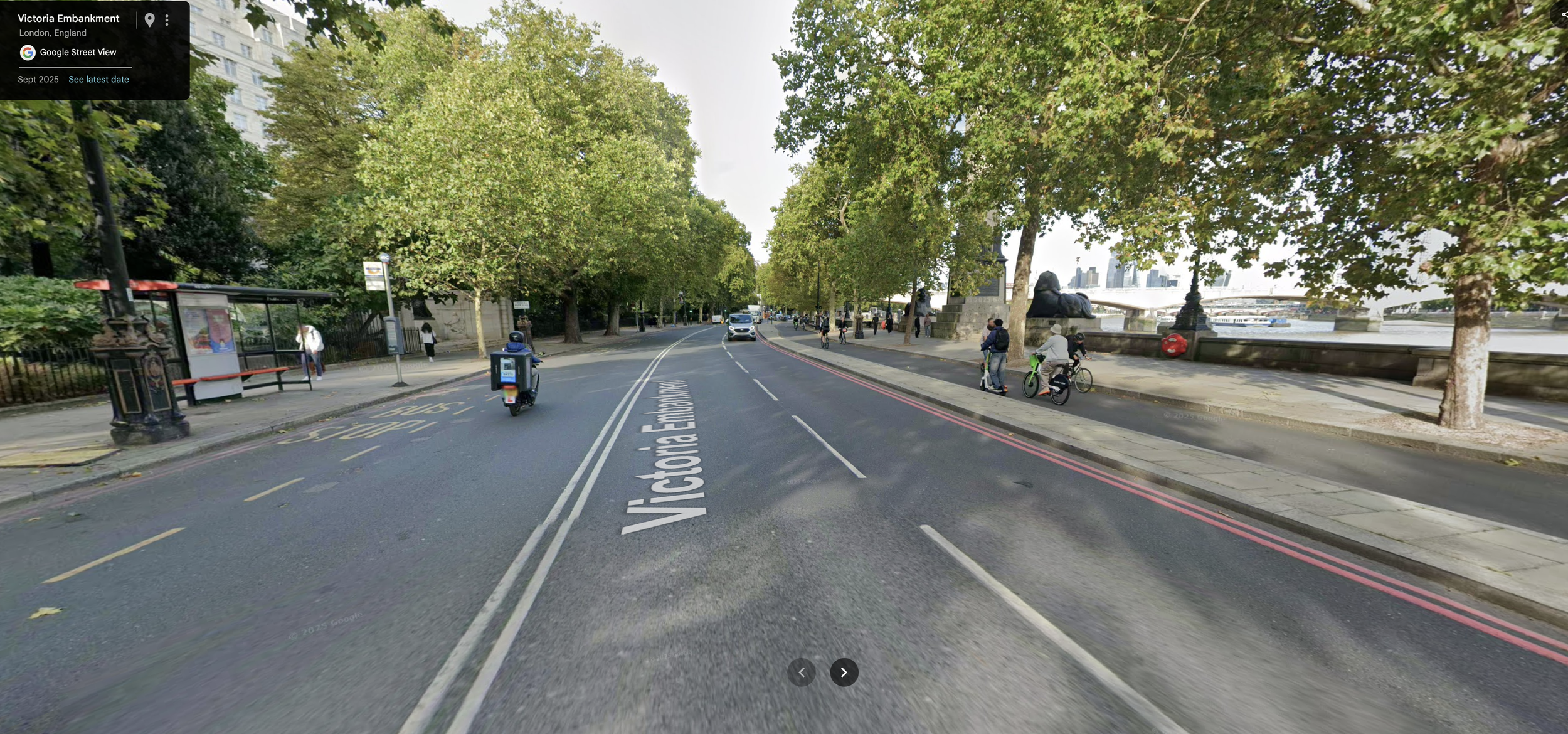
Victoria Embankment today with bike lanes, Map data ©2025 Google
6. Accessibility and social inclusion are transport issues, not social policy side notes
Put step-free stations, accessible buses, and better links to deprived areas into the main objectives. What Happened: while slower on step-free than some scenarios promised, the following 20 years did, in fact, prioritise accessible buses, step-free Tube/rail where feasible, and new links in poorer areas (Overground, Crossrail east, etc.).
7. Pricing and “smart” measures are needed, not just concrete
The strategy saw that congestion charging, workplace/school travel plans, and better traffic management had to sit alongside new infrastructure. The balance in policy was designed to be a logical and well-rounded. TFL do this as a matter of BAU:
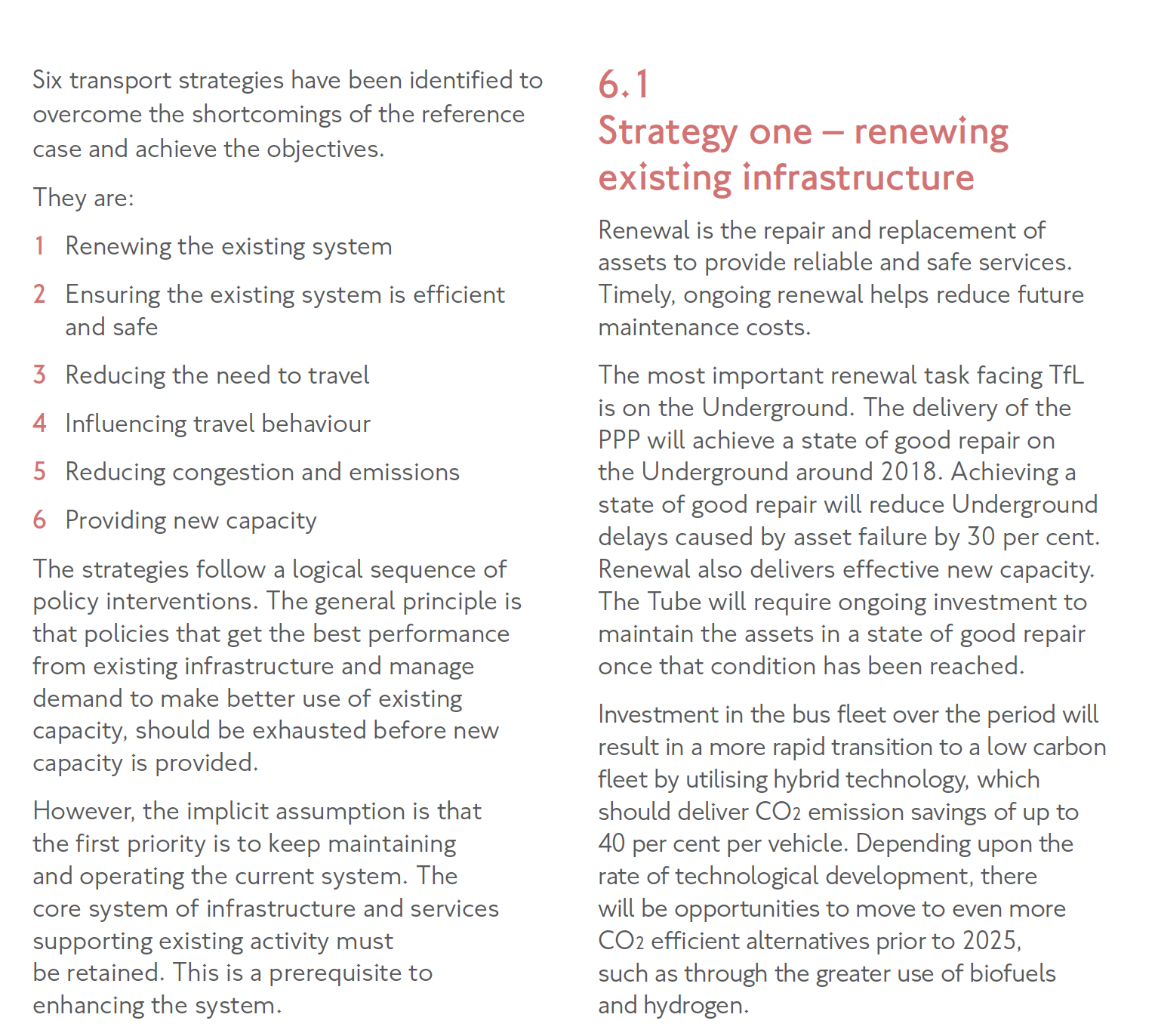
T2025 Policy Framework
Where T2025 was a miss (or over-optimistic)
1. Underestimated London’s population growth (8.6 -> 8.9m ) created by its evolution into a “liveable mega-city”.
2. Overestimating long-term bus growth. T2025 assumed buses would keep growing. Patronage stalled then declined as congestion increased and road space shifted to other priorities.
3. Underestimating outer London’s car dependency. The plan expected buses, rail upgrades and policy changes to reduce car use. Outer London remains highly car dependent, relatively.
5. Missing the surge in vans and deliveries. T2025 focused on people, not freight. It did not anticipate the boom in e-commerce and delivery traffic that now consumes road capacity.
6. Underestimating rising climate ambition. Targets were built around a 30 percent CO₂ cut. Within a decade the bar had moved to net zero and far stricter air quality expectations.
7. Missing smartphones and new mobility models. We foresaw digital tools but not their real impact. Ride-hailing, dockless bikes, e-scooters, MaaS platforms and large-scale remote work were not visible in 2005 and difficult to build into policy. Many strategies still repeat this pattern by applying ideas from elsewhere without considering local context.
My learnings
That early project shaped a lot for me - how I work in teams, how I plan, and what a plan is really for. It also taught me how to balance clear wins with honest misses.
Some specific learnings embeded in our strategies and projects:
Need to be honest about the current state.
While you need to be clear on transport investments, it is likely background factors (population growth, global technology models) that you don’t control over that will have far greater impact. Clear policy is your only response.
A specific direction of travel is far more important than the solution.
Problems need to be articulated clearly and monitored, this article was easy to prepare as TFL and the team produce exceptional reports to update people on how they are tracking.
T2025 is linked below, and all data quoted above can be found online.
T2025
