

Driverless taxis are picking up passengers. Time to pick up the planning.
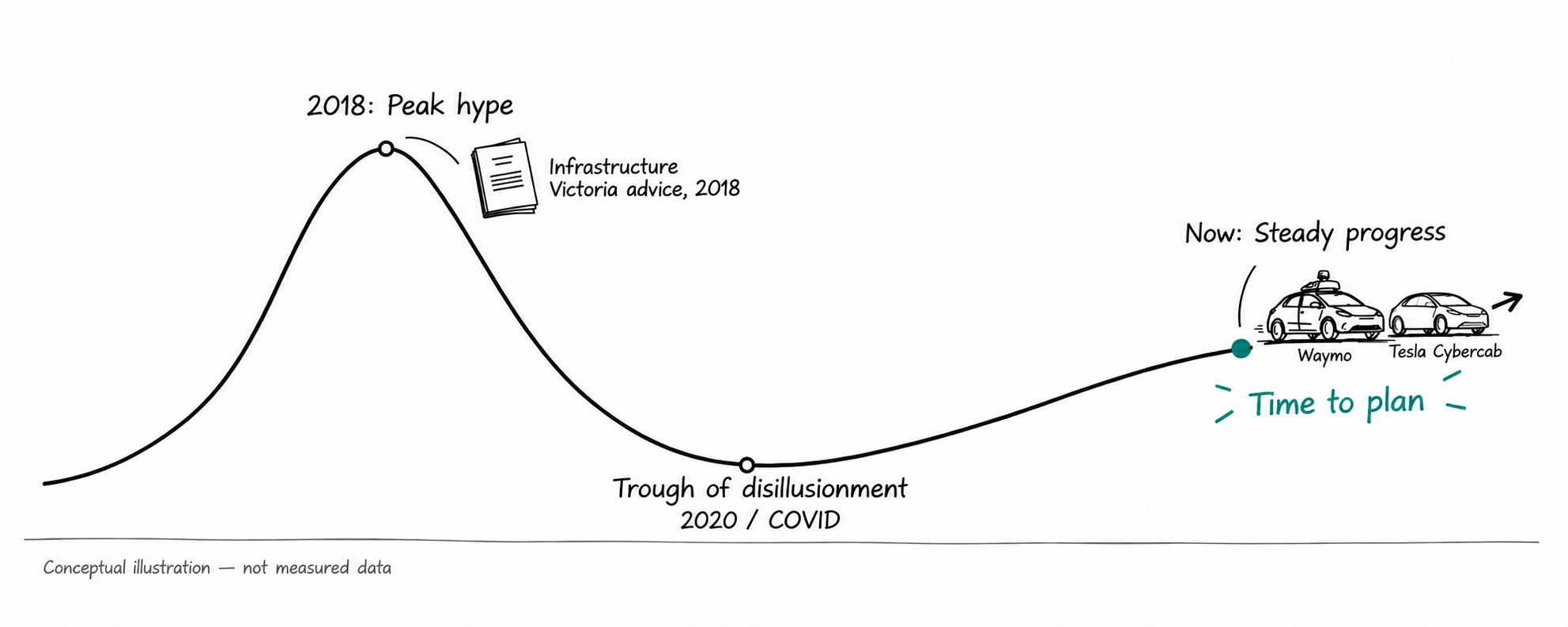
Australia has an opportunity to shape what autonomous taxis deliver for our communities. That work should start now.
Tesla has invited Australians to see its Cybercab, with a showroom tour across seven cities. It is a display rather than an Australian service launch, but it brings the prospect of driverless taxis a little closer to home.
Overseas, the scale is already substantial. Waymo, part of Google’s parent company Alphabet, is reportedly delivering more than half a million paid rides each week and says it operates across 15 cities.
The timing of Australian deployment remains uncertain. The case for preparing is much clearer.
Wait for arrival, or help shape it?
Melbourne’s yellow bikes and shared e-scooters offer a useful prompt: how much should we settle before a new service becomes part of everyday street life?
For autonomous taxis, the potential opportunities include greater independence for people who cannot drive, more travel choices and improved safety. The questions are equally practical. Will services complement public transport? Will empty vehicles add traffic? Who will be able to use them, and which communities will they serve?
These outcomes will depend partly on the technology, and partly on the expectations governments establish.
What the research tells us
A recent international paper by Nuo Chen, Moving beyond policy lag to uneven regulatory institutionalisation in autonomous mobility, examines ten regulatory units across five dimensions.
Its central finding is useful: governments have made more progress on authorisation and liability than on the social and financial arrangements that should accompany deployment.
Equity and labour safeguards, alongside fiscal arrangements, were the least developed dimensions. The paper also identifies a distinction between requiring operators to collect technical data and ensuring public authorities can access useful operational information.
The study examines formal provisions adopted or in force by December 2025. It does not establish how effectively those provisions work in practice. Nevertheless, it provides a useful starting point for Australian preparation.
What the paper highlightsWhat Australian preparation could addressAuthorisation and liability are comparatively advanced.Alongside safety approval, establish how services will contribute to wider transport objectives.Equity and labour safeguards are less developed.Consider accessible vehicles, service coverage, affordability and workforce transition.Fiscal arrangements are less developed.Examine charging and funding implications, distinguishing automation from the separate effects of electrification.Public access to operational data is uneven.Establish what authorities need to monitor services, assess network effects and enforce conditions.
Australian implications are Eukai’s interpretation of the research.
State decisions. Local impacts. Shared benefits.
For state governments, preparation means connecting vehicle and service regulation with network management, public transport, accessibility and funding.
For local government, the questions become tangible: where vehicles stop, how passengers reach them, how streets and kerbs function, and how problems are reported and resolved.
Working together creates the opportunity to agree common expectations, share evidence and reduce duplicated effort. Operators need clarity. Communities need confidence that public benefits are being considered alongside commercial opportunities.
A practical starting point is to define the outcomes sought, identify responsibilities and agree what evidence a trial should provide. That gives a trial a clear purpose and makes its findings useful for the next decision.
Bring experience into the conversation
This is complex work. It takes a detailed understanding of the technology, road operations, government responsibilities and the communities affected.
Eukai has established US partnerships that bring specialist experience in autonomous vehicle trials and deployment into Australian discussions. We combine that experience with local transport planning, operations and practical guidance.
If your organisation is considering what autonomous mobility could mean for its roads or communities, please reach out. We would be happy to facilitate a conversation.
Research reference: Chen, N. (2026). Moving beyond policy lag to uneven regulatory institutionalisation in autonomous mobility. Transport Policy, Article 104439. In press, available online 19 September 2026. https://doi.org/10.1016/j.tranpol.2026.104439.
