

The Incremental Advantage: Why Annual Global Events Could Outperform One-Off Mega Bids
Cities often ask what will transform them. For the select few, the answer has been the Olympic Games. A once-in-a-generation spectacle. A deadline that forces delivery. A global stage that promises renewal. A gamechanger.
Having worked on multiple Olympic Games and have seen the machinery from the inside. I respect the scale and ambition. But experience changes perspective. Living now in Melbourne, watching how the city operates around its recurring global events, I find myself asking a different question.
Not how do we prepare for these events.
It is what repeated events show a city about itself. How it copes. How it coordinates. How it improves.
Cities are not just collections of buildings and asphalt. They are societal systems expressed physically. They shape how people move, gather, trade, and interact. Transport networks reflect social priorities. Public space reflects civic confidence. Major events stress these systems. They reveal whether movement, governance and identity are aligned.
Mega events can influence city systems. Research shows they can act as catalysts for change when there is already momentum (Smith, A. 2012). If policy direction, infrastructure planning and political commitment are in place, an event can accelerate delivery. If they are not, the event cannot create them from scratch.
This is the critical distinction. Mega events amplify trajectories. They do not invent them. Reinvention it would seem is gradual.
An Emerging Melbourne Model
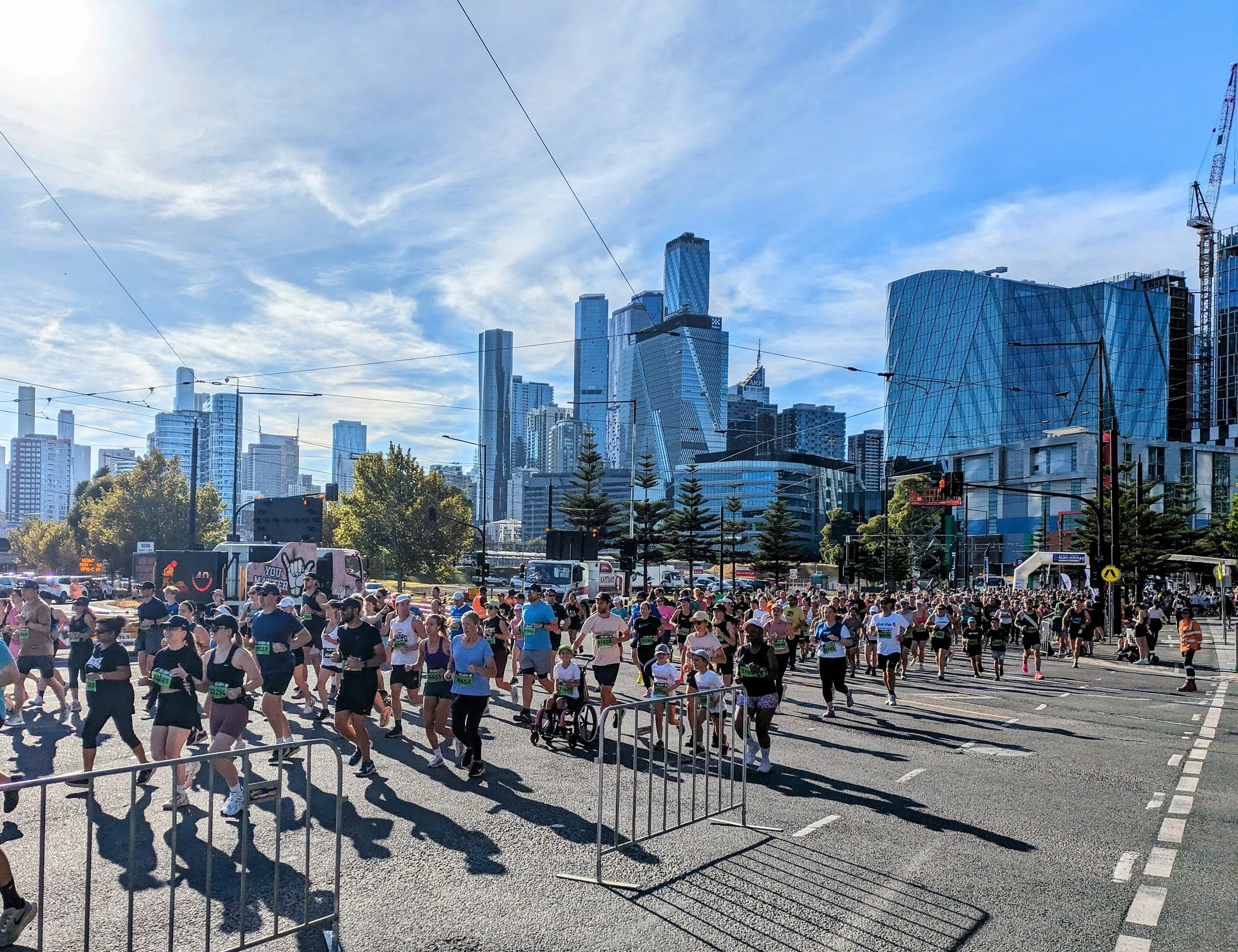
Melbourne offers an emerging alternative to the once-in-a-generation bid cycle. It hosts global events annually. The Australian Grand Prix. The Australian Open. These are not rare disruptions. They are becoming parts of the city’s rhythm.
Each year, transport systems adjust. Networks are reoriented. Ticketing systems are integrated. Road access changes. Pedestrian bridges and temporary structures manage flows. Residents anticipate the disruption. Businesses prepare. Authorities test and refine operations. Then evaluation occurs.
There is no need for emergency governance or dramatic public messaging. The systems are rehearsed. The city absorbs the event because the event is increasingly embedded in the city.
This learning model is still evolving. But its power lies in repetition.
The Evolution of the Grand Prix
When the Grand Prix moved to Albert Park in the 1990s, it relied heavily on temporary overlays. Over time, infrastructure has improved incrementally.
To contextualise the Grand Prix track location in Melbourne, it is in an area that doesn’t have heavy rail and is served by light rail and tram. It is also bound by major roads (4-8 lanes).
Pedestrian bridges have been refined to manage crowd movement more efficiently. Access points have been rationalised. Tram services have been better synchronised with event peaks. Traffic management has become more precise, informed by previous years’ data. The new Anzac station offers opportunity to decrease the reliance on local space that is has competing demands - uber, public transport and local residents.
Safety upgrades and track reconfigurations have enhanced global competitiveness. Broadcast facilities have modernised. Sustainability initiatives are now part of the conversation.
No single year delivered a revolution. But across decades, marginal gains have compounded.
The event becomes a testing ground for mobility logistics. It becomes a stress test for tram priority and pedestrian permeability - a way to make the most of new infrastructure.
These are capabilities - when invested in locally - that extend beyond race weekend.
The Evolution of the Australian Open
The Australian Open tells a similar story.
Melbourne Park began as a purpose-built precinct. Since then, roofs have been added. Amenities upgraded. Public spaces redesigned to manage summer heat and crowd density.
Transport integration has matured. Trams and trains feed efficiently into the precinct. Wayfinding has improved. Day passes and integrated ticketing have made access simpler.
The event experience has also expanded outward. Better food offerings. City-wide hospitality tie-ins. A January atmosphere that links sport with culture and tourism. The numbers suggest people are responding.
The Open now feels less like an isolated tournament and more like a city-wide activation. It anchors the beginning of the year. There is a tone and tempo in Melbourne that is recognisable as being different - you walk more, take the long way home, and dwell a bit more in the city.
Again, this did not happen through a single transformational leap. It happened through iteration.
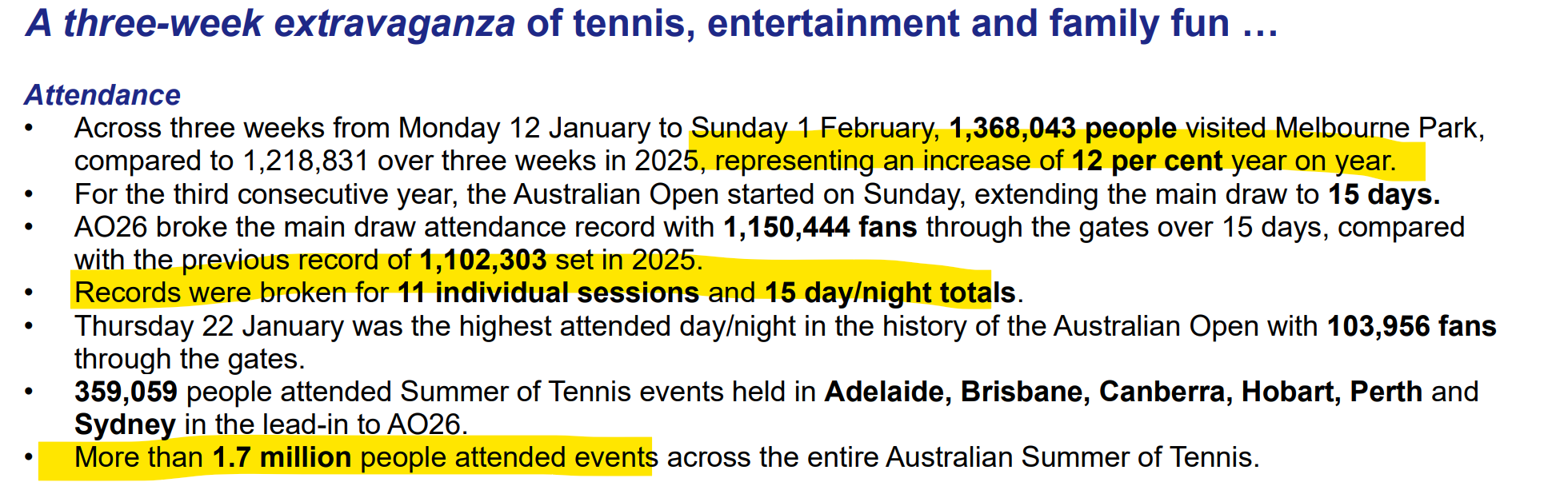
Tennis by the numbers highlights extent of event in 2026
The Philosophy of Marginal Gains
These outcomes - on a grand scale - reflect the benefits of adopting a philosophy of ‘marginal gains’. Small and large improvements. Repeated annually. Evaluated. Feedback positive and negative. Adjusted quickly.
Annual global events allow cities to pilot new transport approaches. Test integrations. Refine pedestrian management. Trial sustainability measures. Build procurement capability. Strengthen local supply chains. Build up knowledge in local suppliers.
Over the last few years, for example, the Grand Prix with established changed to the public transport network, has had to adjust to e-scooters, and continued increases in ride-sharing. Over the next few years, there is the opportunity of a new train station, and autonomous fleets are only just around the corner.
In annual events, failures are remembered by individuals. Learning cycles are short. Institutional knowledge accumulates.
By contrast, the Olympic model compresses risk into a narrow window. A single deadline. A single global judgment. Atlanta we’re looking at you. A single financial exposure. For this reason, Cost overruns are the norm. Cities and countries pay. The financial volatility of Olympic delivery is well documented.
When pressure is concentrated, adaptability is reduced.
The ‘potential’ of a Games relatively are x6 annual events, but is this actually real?
The Olympic Games remain attractive for one overriding reason. The scale of their projected economic impact dwarfs that of any annual event.
On paper, the projected economic uplift of the Brisbane Olympic Games far exceeds the annual contribution of the Australian Open or the Formula One Grand Prix. The capital investment is larger. The global broadcast reach is broader. Click through for more detail on the economic benefit of each event
-
The 2023 Formula 1 Australian Grand Prix delivered an estimated $268 million in economic benefit to Victoria, according to an independent impact assessment commissioned by the Victorian Government (EY for DJPR/DJSIR). The estimate is based on visitor expenditure, interstate and international tourism uplift, and event-related operational spending, and measures net new economic activity rather than total turnover. The model assumes displacement and leakage effects are accounted for and reports impact in gross state product terms for the event year.
-
The 2024 Australian Open generated an estimated $533.2 million in economic benefit to Victoria, based on independent analysis reported by Tennis Australia (Nielsen Sports). The figure reflects visitor spending, tourism nights, media exposure effects, and event operations, measured as net economic contribution to the state economy. The modelling assumes additional visitation attributable to the event and excludes routine local spending that would have occurred regardless.
-
The Brisbane 2032 Games are projected to deliver $4.6 billion in economic uplift to Queensland (2021 dollars) over a 20-year period, according to KPMG analysis commissioned by the Queensland Government. The estimate measures gross state product uplift from Games delivery, tourism, trade, and legacy infrastructure effects. It assumes long-term catalytic benefits beyond the event year and models net additional economic activity rather than total project expenditure.
But forecasts are not outcomes.
Economic projections for mega events are typically built on estimated infrastructure costs, visitor numbers and long-term legacy multipliers. History shows that actual delivery costs frequently exceed initial projections. When capital expenditure escalates, the net economic benefit narrows. In some cases, it evaporates.
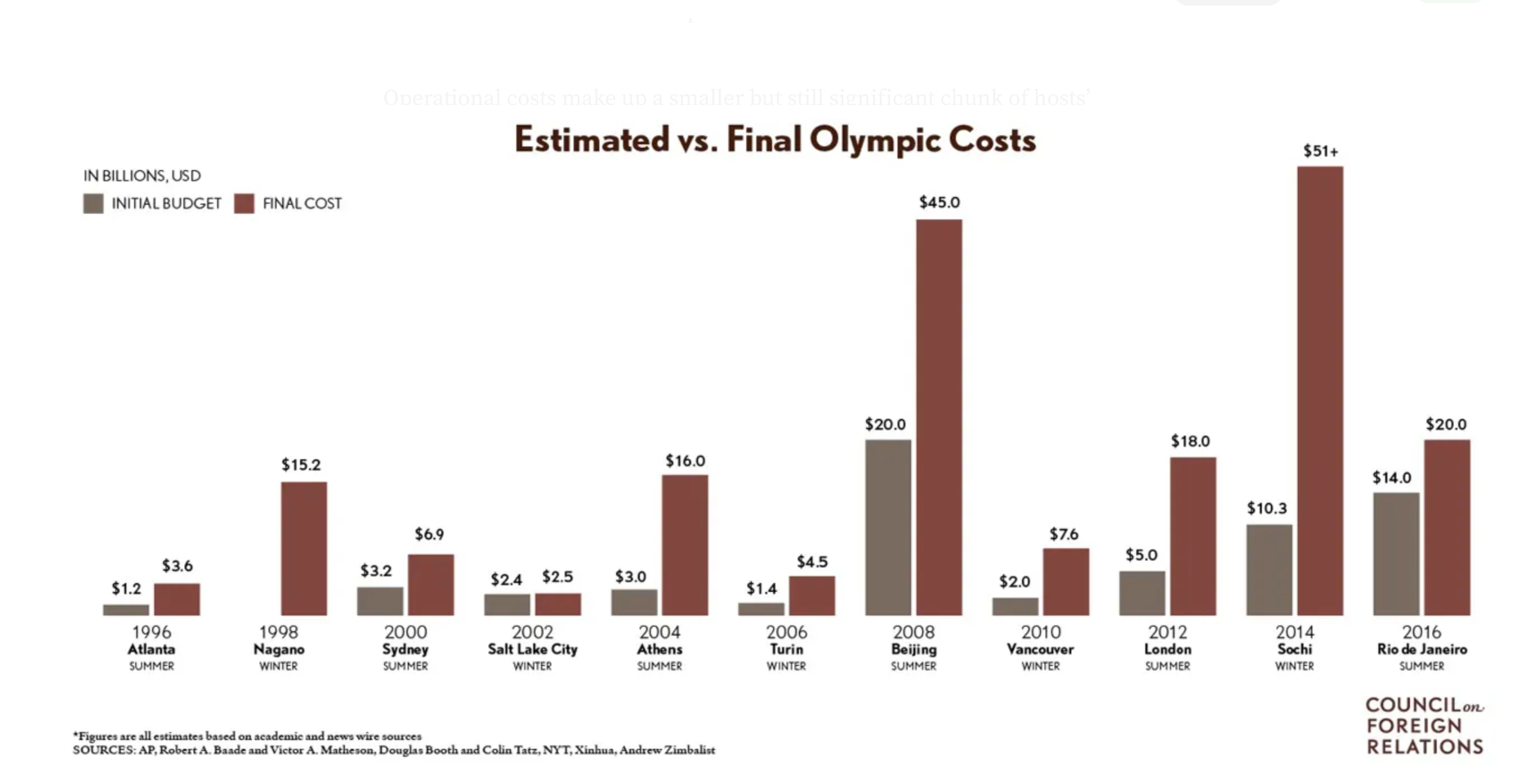
Now older research into the cost of Games
London 2012 and the Acceleration Effect
London 2012 is often cited as proof that the Olympics can transform a city. The regeneration of East London, the investment in Stratford, and the transport upgrades are held up as legacy successes.
But the key point is that these projects were underway before the Games. The Jubilee Line Extension and wider East London regeneration strategies predated the bid. The Olympics accelerated momentum that already existed. They did not create it.
The same was true in London in 2007 when the Tour de France Grand Départ passed through the city. I worked on that project. It showcased cycling to a global audience. It energised local enthusiasm. But London’s commitment to cycling infrastructure was already emerging. The event amplified an existing shift.
Events reveal direction. They do not set it.
Annual Events as Urban Incubators
Annual global events function as urban incubators. They provide a recurring platform to test how people move through a city. They stress transport systems in predictable ways. They encourage coordination between agencies. They support local business ecosystems.
They also connect urban systems to societal behaviour. How people travel to an event reflects broader mobility culture. How public space is used reflects civic norms. Events become mirrors for everyday life.
Over time, the city becomes better at moving people. Better at integrating technology. Better at communicating disruption. Better at aligning infrastructure with social patterns.
These are transferable capabilities. They matter long after the grandstands are removed.
The Counterpoint
The Olympic Games remain unique. Few events command such global attention. Few can touch housing, transport, social policy and national identity simultaneously.
The catalytic potential is real.
But only if there is fuel.
If governance is weak, the Olympics expose it. If transport systems are fragile, they are stressed. If political consensus is thin, it fractures.
The Games amplify capacity. They do not manufacture it.
The Real Question
So the strategic question for major cities is not how to prepare for the Olympics.
It is how an event platform can prepare the city.
Do we want a single moment of global spectacle. Or do we want repeated cycles of testing, learning and refinement.
Circus Maximus delivered awe. It demonstrated power. It gathered crowds.
But it did not build institutional capability through repetition.
Annual global events may lack the singular drama of an Olympic opening ceremony. They may not promise stratospheric change. Yet their cumulative effect can be profound.
They align asphalt with society. They link infrastructure with behaviour. They refine how people move and gather.
Over twenty years, marginal gains compound.
The city that improves a little every year may ultimately travel further than the one that waits a decade for a single leap.
The question is not whether the Olympics can change a city.
It is whether the city is already changing.
If it is, any event can help.
If it is not, no event will save it.
